
Pike County Court Records After a Jail Arrest
After a Pike County arrest, the first public question is often whether someone is in custody. That is a jail question handled through Pike County Correctional Facility and related custody channels. The later question is different: what criminal case exists, what charges were filed, and what the court has done with them. Pike County's Clerk of Courts is the criminal-record custodian for common pleas filings. The clerk page identifies criminal records as motions, pleadings, transcripts, and other filings related to a criminal case, with public viewing through Pennsylvania's Unified Judicial System except for juvenile, dependency, sealed, and confidential matters.
That distinction matters because Pike County does not publish an official online jail roster or current-inmate booking report. For custody status and facility routing, use jail inmate records. For booking photos and why there is no confirmed Pike County mugshot gallery, use jail mugshots. Court records after an arrest are about filed charges, docket events, bail entries, charge status, prosecutor action, and final disposition. They are not a substitute for a Pennsylvania State Police background check, and they may lag recent filings.
The local offices are split between Milford and Lords Valley. The Clerk of Courts, Yvonne Merrill, is at 412 Broad Street, Suite 1, Milford, PA 18337, and the clerk's office phone is 570-296-7231. Pike County Courts are Pennsylvania's 60th Judicial District. The county jail, Pike County Correctional Facility, is in Lords Valley and handles the custody side after booking.
How to Find Pike County Court Records After an Arrest
The main statewide search path is Pennsylvania UJS Case Search. Use it after a case has been filed or docketed. UJS can be searched by participant name, docket number, OTN, complaint number, incident number, SID, county, judicial district, and other routes depending on the selected tab. For a Pike-only search, use Pike as the county or Pike - 60 as the judicial district when those filters are available.
- Open UJS Case Search and choose the search route that matches the information available, such as participant name, docket number, OTN, complaint number, or incident number.
- Use Pike County or Pike - 60 Judicial District filters when possible, especially for common names.
- Open the docket result and read the charge list, docket events, bail entries, scheduled proceedings, and case status.
- Compare each charge's description, grading, status, disposition, and financial entries instead of assuming the first arrest allegation remained unchanged.
- For verified copies or uncertainty about a recent filing, contact the Pike County Clerk of Courts or visit the court during regular business hours.
The UJS search interface is broad enough to support several identifiers, which is useful when a name search produces too many results. The Pennsylvania docket-sheet page also warns that docket sheets are not a replacement for an official criminal-history background check.
The statewide UJS Case Search screen shows the public docket fields used for court records after an arrest.
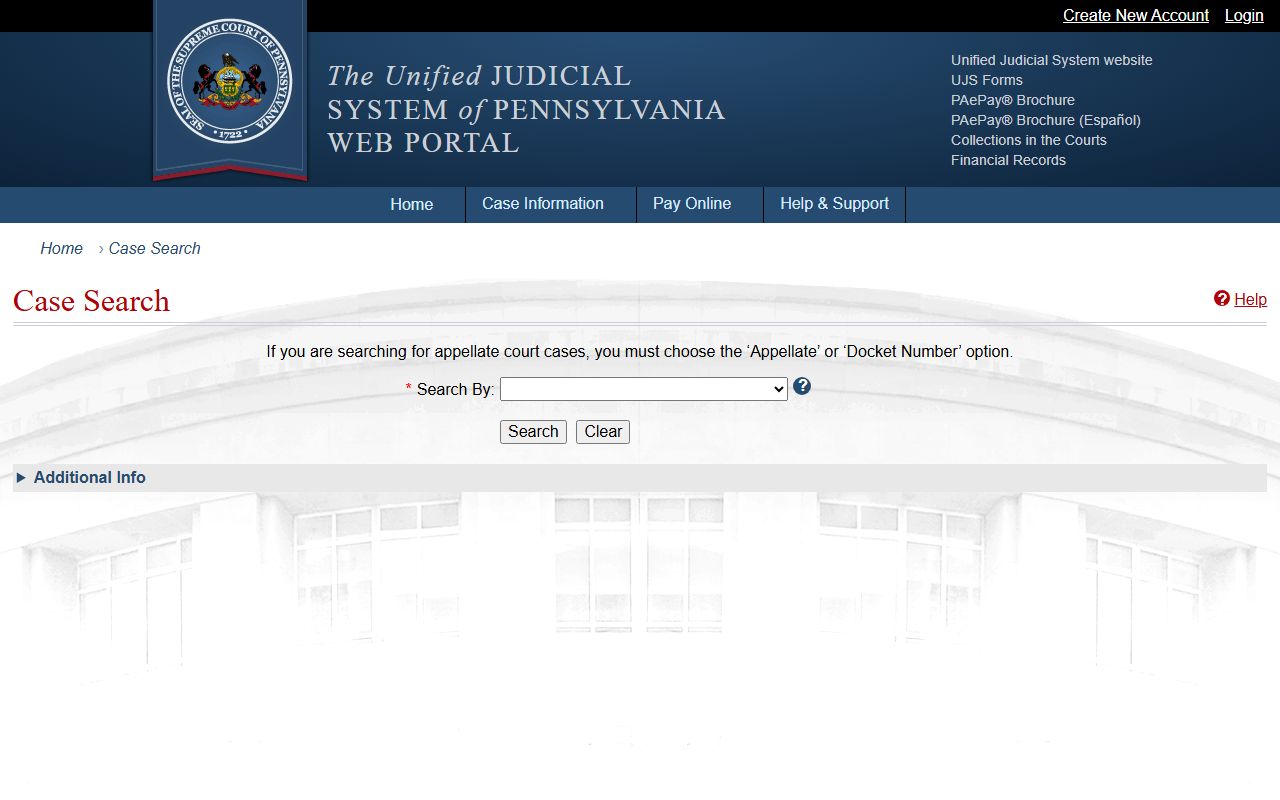
Use those fields to narrow Pike County docket results before relying on a name match.
| UJS Search Field | Best Use in Pike County | Notes |
|---|---|---|
| Participant Name | Search by defendant name when no number is available. | Use other filters for common names. |
| Docket Number | Find a known case directly. | Most precise when a citation, filing, or notice supplies it. |
| OTN | Connect criminal processing records to a docket. | Useful when paperwork lists the offense tracking number. |
| Complaint or Incident Number | Search from police or charging paperwork. | May help before a docket number is known. |
| SID | Search by state ID route. | Not needed for most public searches. |
| County / Judicial District | Limit results to Pike or Pike - 60. | Pike County Courts are the 60th Judicial District. |
Pike Local Court Search and Verified Records
Pike County also has a local court record-search page at pikecountycourt.org. Its disclaimer says court data is current only within the limits of the retrieval system and that the delay between a filing or judicial action and online posting can be at least 24 hours and may be longer. It also directs users who need verified information to request it from Pike County Court by mail or obtain it in person during regular court hours.
The local Pike County court search disclaimer is a useful warning for any search immediately after a jail arrest.
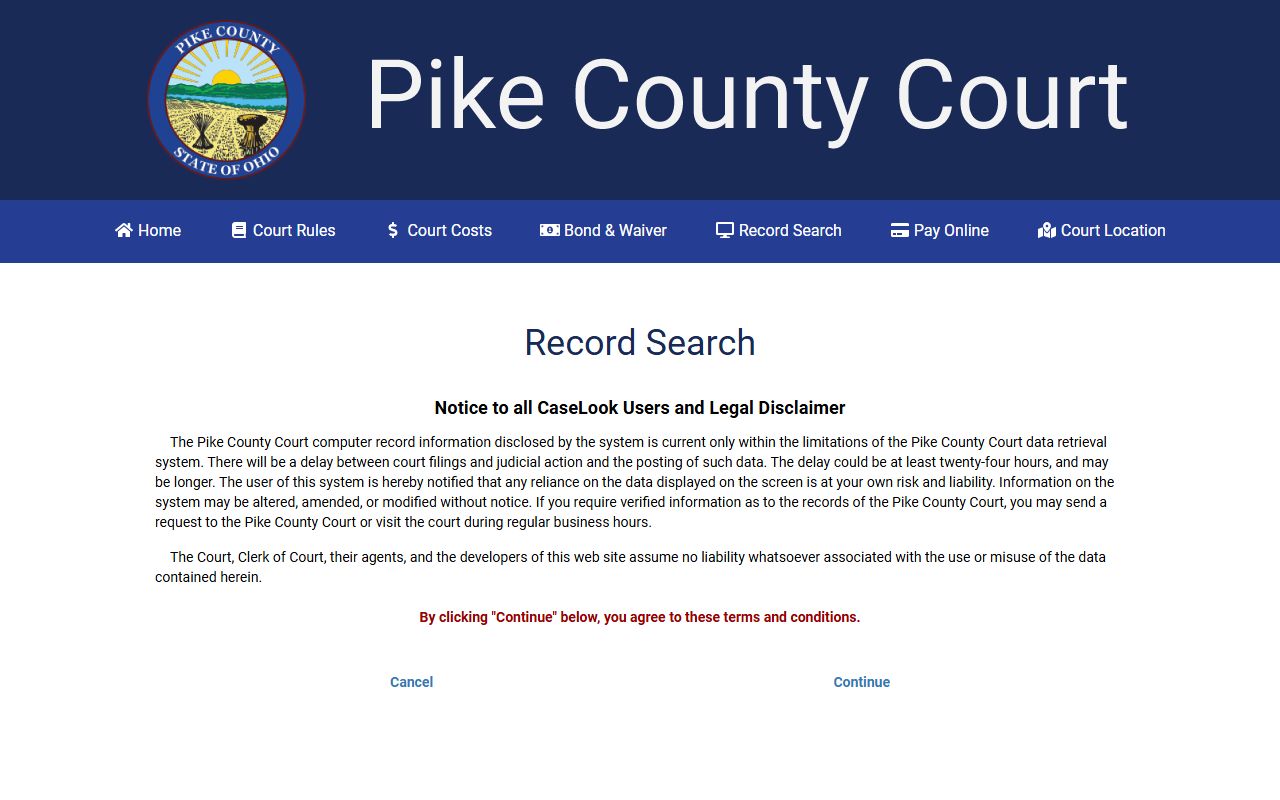
When the timing is close to booking, a missing result may mean the docket is not posted yet, not that no case exists.
Charging Documents After a Pike County Arrest
Booking at Pike County Correctional Facility starts the custody record. The court case starts when a charging document and docket activity reach the court system. Pennsylvania criminal cases often begin at the magisterial district judge level, then may move forward after preliminary proceedings. If charges are held for court or otherwise filed in common pleas, the Pike County Clerk of Courts maintains the criminal court record.
| Record or Filing | What It Usually Shows | Where to Look |
|---|---|---|
| Criminal Complaint | Initial allegations, offense dates, charge descriptions, and the arresting or filing agency. | UJS docket, magisterial court, or verified court request. |
| Affidavit or Supporting Papers | Probable-cause detail when public and not sealed or otherwise restricted. | Court file request; access can be limited. |
| Information or Common Pleas Filing | Formal prosecutor-filed charges after the case moves forward. | Pike County Clerk of Courts. |
| Docket Sheet | Events, hearings, bail actions, charge status, dispositions, and financial entries. | UJS Case Search and clerk records. |
Charge Status in Court Records After an Arrest
Charges can change after an arrest. A charge may be held for court, amended, reduced, dismissed, withdrawn, resolved through a plea, or placed into a program such as ARD when eligible and approved. DA Ray Tonkin's office prosecutes Pike County criminal cases and may file, amend, reduce, or resolve charges after the initial arrest or booking allegations. DA Crimewatch news posts are public law-enforcement content, but they are not a substitute for UJS and Clerk of Courts records.
| Status | What It Means | Search Caution |
|---|---|---|
| Pending | The charge or case remains open. | Look for upcoming hearing dates and bail entries. |
| Held for Court | The case moved from magisterial proceedings toward common pleas handling. | Check for a common pleas docket or clerk filing. |
| Amended / Reduced | The prosecutor or court changed the charge or its grading. | Do not rely only on the arrest allegation. |
| Dismissed / Withdrawn | The charge is no longer proceeding in that case. | Other charges or dockets may still exist. |
| Disposition | The court outcome for a charge, such as plea, verdict, dismissal, or program result. | Read each charge separately. |
Bail, Preliminary Arraignment, and Release After an Arrest
Pennsylvania Rule of Criminal Procedure 540 governs preliminary arraignment. At that stage, the issuing authority may address rights, charges, a preliminary hearing date, and bail or release conditions. Rule 540 also connects monetary bail to Rule 528, which governs monetary conditions and allows percentage cash bail when the bail authority finds a deposit sufficient. Pike County research did not locate a county jail page listing online bail payment, local kiosk bail payment, or a bondsman procedure, so current payment and release questions should be verified with the court or jail.
| Bail or Hold Type | How It Works |
|---|---|
| Release on Recognizance | Release based on court conditions and a promise to appear, without a cash deposit. |
| Monetary Bail | A financial condition set by the bail authority under Pennsylvania procedure. |
| Percentage Cash Bail | A deposit of up to 10 percent of the full monetary condition when authorized under Rule 528. |
| Surety or Property Security | Security accepted when allowed by rule and local court handling. |
| No-Release Hold | Another legal hold, such as ICE, parole/probation, federal custody, or another warrant, may prevent release even if one docket shows bail. |
For criminal court record questions after the case reaches common pleas, call the Pike County Clerk of Courts at 570-296-7231. For custody or release processing at the jail, call Pike County Correctional Facility at 570-775-5500.
Warrants That Lead to an Arrest
The Pike County Sheriff's Office, led by Sheriff Brian M. Vennie, publishes an active bench-warrant PDF through its Licenses, Permits, and Warrants page. The warrant list is dated June 1, 2026 and is name-only. It does not show charges, case numbers, bond, issuing judge, date of birth, address, mugshot, or a search form. A browser or PDF find command can search the text, but it is not a live database.
An arrest or surrender on a bench warrant may result in booking at Pike County Correctional Facility. Once booked, custody questions go to the jail. Court questions go to UJS, the Clerk of Courts, or the magisterial/common pleas court on the docket. Contact the Sheriff's Office at 570-296-6459 or at 412 Broad Street, Suite 5, Milford, PA 18337 when a warrant issue needs confirmation.
Charges vs. Convictions
An arrest and a filed charge are accusations. A conviction is a later court outcome, usually through a guilty plea, verdict, or other final adjudication. Pike County court records can show both accusations and outcomes, so each charge line should be read through to disposition before drawing conclusions.
| Charge | Conviction | |
|---|---|---|
| Stage | Filed allegation after arrest or court action. | Final guilt finding or plea outcome for a charge. |
| Proof Standard | May begin from probable cause and charging decisions. | Requires proof beyond a reasonable doubt or an accepted plea. |
| Can Change? | Yes, charges can be amended, reduced, dismissed, or withdrawn. | May later be affected by appeal, expungement, or limited-access relief. |
| Where Shown | UJS docket and court filings when public. | Docket disposition fields and final court entries when public. |
Sealed vs. Expunged Court Records After an Arrest
Pennsylvania's Criminal History Record Information Act, Title 18 Chapter 91, controls criminal-history dissemination, expungement, and limited access. Section 9122 governs expungement in eligible criminal proceedings. Sections 9122.1 and 9122.2 provide limited-access and Clean Slate pathways for qualifying records. Pike County's Clerk of Courts page also notes that juvenile, dependency, sealed, and confidential filings are not publicly viewable through UJS.
| Limited Access / Sealed | Expunged | |
|---|---|---|
| Public Visibility | Public access is restricted for qualifying records. | Qualifying criminal-history information may be removed under the statute. |
| Legal Basis | 18 Pa.C.S. 9122.1 and 9122.2. | 18 Pa.C.S. 9122. |
| Agency Access | Some justice or authorized access may remain depending on the statute. | Access is narrower but depends on the court order and law. |
| Best Route | Review eligibility and court procedure before assuming a record will disappear online. | Use the court process rather than commercial removal claims. |
Background Check Considerations
UJS and Pike County court records help explain what happened in court after an arrest, but they are not a consumer background-check product. The Pennsylvania courts caution that public docket sheets should not replace a Pennsylvania State Police background check. Court records also may omit sealed, juvenile, dependency, confidential, or very recent filings.
Important: This site is not a consumer reporting agency and its information may not be used for FCRA-covered screening decisions.
Restricted Court Records After an Arrest in Pike County
Public access is shaped by the Pennsylvania Right-to-Know Law, CHRIA, court rules, and confidentiality limits. RTKL Section 708 places the burden on an agency to prove a public-record exemption, but exemptions can still apply to criminal-investigative records, noncriminal-investigative records, personal security, medical information, juvenile matters, sealed records, and confidential court filings. CHRIA Section 9121 governs criminal-history dissemination by Pennsylvania State Police and other agencies. When a record is not online, use the originating office for verification rather than assuming the record does not exist.
The Pike County District Attorney's Office, led by DA Ray Tonkin, uses Crimewatch for news, arrests, most wanted, forms, ARD information, victim services, and tip tools. Crimewatch posts are official law-enforcement communications, but the docket and Clerk of Courts remain the court-record path for charges after a jail arrest.